Lantmännen is an agricultural cooperative owned by Swedish farmers and is Northern Europe's leading player in agriculture, machinery, bioenergy and food.
Lantmännen
Lantmännen Finans
Lantmännen Fastigheter
Agriculture
Offers products and services for a strong and competitive agriculture. Imports, markets, sells and maintains agricultural machinery.
Lantmännen Lantbruk
LM2
Odla
Machines
Imports, markets, sells and maintains agricultural machinery.
Lantmännen Maskin
Online store
Energy
Harnessing the power of nature to create smart, climate-friendly energy solutions. Offers biofuels, feed and raw materials that make a difference for both customers and the climate.
Lantmännen Biorefineries
Food
Offers tasty, safe and sustainable products with some of the Nordic region's most beloved brands. Develops foods that simplify everyday life and meet the needs of the future.
Lantmännen Cerealia
Lantmännen Unibake
From field to fork
Lantmännen is an agricultural cooperative and Northern Europe's leading player in agriculture, machinery, bioenergy and food. Lantmännen is owned by 17,000 Swedish farmers with operations throughout the value chain from field to fork.
Our digital tools
LM²
This digital tool is aimed at you as a farmer. Here you buy grain, perform checkout services, order feed and spare parts for your machines and much more. Works just as well on mobile as on desktop.
More about LM2
The Lantmännen card
The Lantmännen card is for those who are active in the green industries, and shop at about 40 million places globally. Fuel discounts at almost 2000 stations in Sweden.
Log in
E-capital account
Lantmännen Finans savings account gives you good interest from the first krona, unlimited withdrawals and no fees. Here you can log in/open an e-capital account (savings account) with BankID.
Lantmännen is an agricultural cooperative owned by Swedish farmers and is Northern Europe's leading player in agriculture, machinery, bioenergy and food.
Lantmännen
Lantmännen Finans
Lantmännen Fastigheter
Agriculture
Offers products and services for a strong and competitive agriculture. Imports, markets, sells and maintains agricultural machinery.
Lantmännen Lantbruk
LM2
Odla
Machines
Imports, markets, sells and maintains agricultural machinery.
Lantmännen Maskin
Online store
Energy
Harnessing the power of nature to create smart, climate-friendly energy solutions. Offers biofuels, feed and raw materials that make a difference for both customers and the climate.
Lantmännen Biorefineries
Food
Offers tasty, safe and sustainable products with some of the Nordic region's most beloved brands. Develops foods that simplify everyday life and meet the needs of the future.
Lantmännen Cerealia
Lantmännen Unibake
From field to fork
Lantmännen is an agricultural cooperative and Northern Europe's leading player in agriculture, machinery, bioenergy and food. Lantmännen is owned by 17,000 Swedish farmers with operations throughout the value chain from field to fork.
Our digital tools
LM²
This digital tool is aimed at you as a farmer. Here you buy grain, perform checkout services, order feed and spare parts for your machines and much more. Works just as well on mobile as on desktop.
More about LM2
The Lantmännen card
The Lantmännen card is for those who are active in the green industries, and shop at about 40 million places globally. Fuel discounts at almost 2000 stations in Sweden.
Log in
E-capital account
Lantmännen Finans savings account gives you good interest from the first krona, unlimited withdrawals and no fees. Here you can log in/open an e-capital account (savings account) with BankID.
Wheat starch could help hold tomorrow's batteries together. In the FieldToEnergy research project, researcher Illia Dobryden at RISE is exploring whether wheat starch can replace fossil-based binders – making Swedish battery manufacturing greener and less import-dependent.
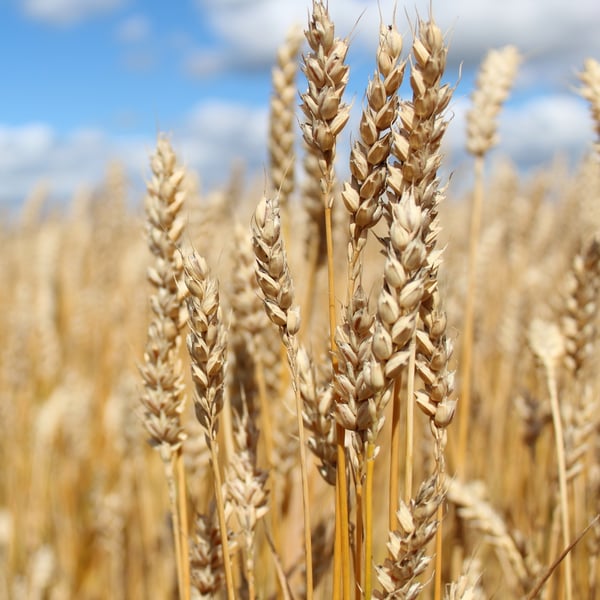
Wheat starch from Swedish fields is on its way to becoming an unexpected key component in lithium-ion batteries. That is the core of the research project FieldToEnergy, where researcher Illia Dobryden at RISE, funded by Lantmännen Research Foundation, is exploring wheat starch as a battery binder. The aim is to investigate whether fossil-based chemicals can be replaced with something that already exists in large volumes.
Illia Dobryden holds a PhD in physics from Luleå University of Technology and continued his research at KTH before joining the research institute RISE in 2021. Since then, he has worked on developing sustainable binders for lithium-ion and sodium-ion batteries – and that is where the connection to agriculture began.
– Today, lithium-ion batteries are manufactured using solvents like NMP, a chemical that is toxic and difficult to handle. The binders used are often PFAS-based or made from fossil raw materials. We saw a need to move towards water-based manufacturing, which in turn opens the door to bio-based binders, Illia explains.
We saw a need to move towards water-based manufacturing, which in turn opens the door to bio-based binders.
/Illia Dobryden
Researcher at RISE
/Illia Dobryden
Researcher at RISE
Beyond the environmental case, there is also a straightforward business argument. A new binder needs to be able to compete on both performance and price to stand a real chance in the market.
– This is where agriculture turned out to have a lot to offer. Starch exists in large volumes and is very price-competitive. That's how the journey started, Illia says.
A genuinely critical role A battery is built from vast numbers of microscopic particles, such as graphite in the anode, which together store and release energy. But the particles do not hold together on their own. Without something to hold them together and anchor them to the metal surface they sit on, they would simply come loose. That is the role of the binder – an invisible but essential glue that holds the battery together.
Not just any starch In the project, Lantmännen supplies the raw material, wheat starch, while RISE develops the binder formulation and tests it in actual battery cells. The project is currently in its second phase.
Starch, however, is far from a simple material. The composition of amylose and amylopectin, two building blocks with different molecular structures, varies between crops, soils and growing conditions, and affects how the starch functions as a binder.
– Wheat starch has a particular balance between amylose and amylopectin, which requires a specific process to make it usable in batteries. A large part of our work is about understanding that process in depth, says Illia.
Before the starch can be used as a binder, it must be heat-treated to break its structure, a process called gelatinization. Concentration and how vigorously the material is mixed also affect the outcome.
The proof is already there The project is no longer just an idea on the drawing board. The researchers have built test batteries, in the same small format as the batteries in a wristwatch, and shown that the technology works.
– We have a working demonstrator. Performance is comparable to conventional binders at slow charging rates, Illia reports. The next step in the project is to verify performance at higher rates and at larger scale.
The results have already drawn interest from the research community. The project has been presented at a major international conference, organised by the publisher Elsevier.
Greener batteries and less reliance on imports If wheat starch can be implemented at larger scale, Illia sees a clear benefit. Demand for more sustainable battery manufacturing is growing in Sweden and Europe, while overall battery production continues to increase.
– The dream scenario is that we can show Swedish industry moving towards PFAS-free and bio-based solutions, with fewer imported raw materials. That strengthens our resilience, while we have both agriculture and battery manufacturing here in Sweden, says Illia.
Before that vision can become reality, further development work remains such as improving the binder's stability and performance, and verifying the results at larger scale. The project is expected to run for just over another year.
– It's not every day you see agriculture and battery technology come together like this. Without the support of Lantmännen Research Foundation, this project wouldn't have been possible, Illia concludes.