Satellites and sensors strengthen the farmer's ley cultivation
No one knows their fields better than the farmer who grows them, but even the most experienced farmer does not see and understand everything. At SLU in Umeå, researchers Julianne de Castro Oliveira and Sanna Bergqvist are working on allowing satellites and sensors to complement the farmer's gaze when cultivating ley. The goal is to understand why some parts of the fields give lower yields than others. The method is based on the principles of precision agriculture and can improve nitrogen fertilization with positive effects for both the economy and the environment.
Forage crops are the backbone of Swedish dairy and beef farming. But fields for ley productionare rarely uniform. Some zones reliably produce high yields, others persistently underperform, and the same amount of fertiliser can give very different results depending on where in the field it lands. That variation is exactly what this research project, funded by Lantmännen Research Foundation, is trying to get to the bottom of.
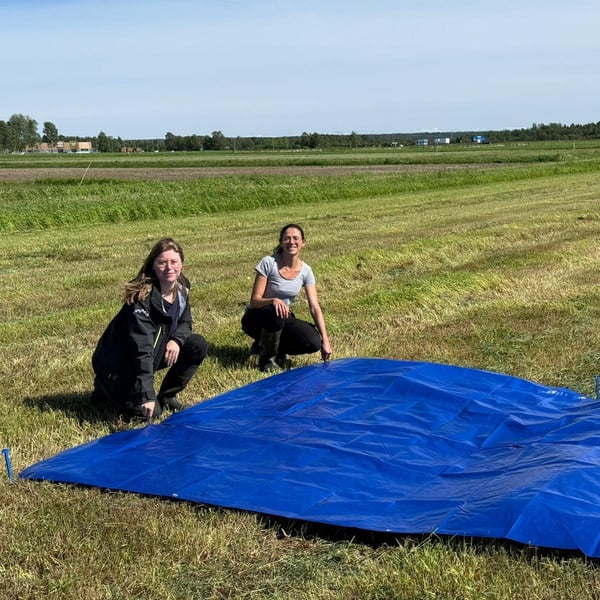
Julianne de Castro Oliveira is a researcher at the Department of Crop Production Ecology and leads the project. Sanna Bergqvist is a doctoral student in the same research group. Together, they use remote sensing to track how crop biomass varies across time and space, and to identify the causes behind that variation.
– Farmers have a lot of knowledge about how their fields are doing. They don't need us to tell them what's going on. But we can support them by giving them a spatial view, an overview that's hard to get on your own, says Julianne de Castro Oliveira.
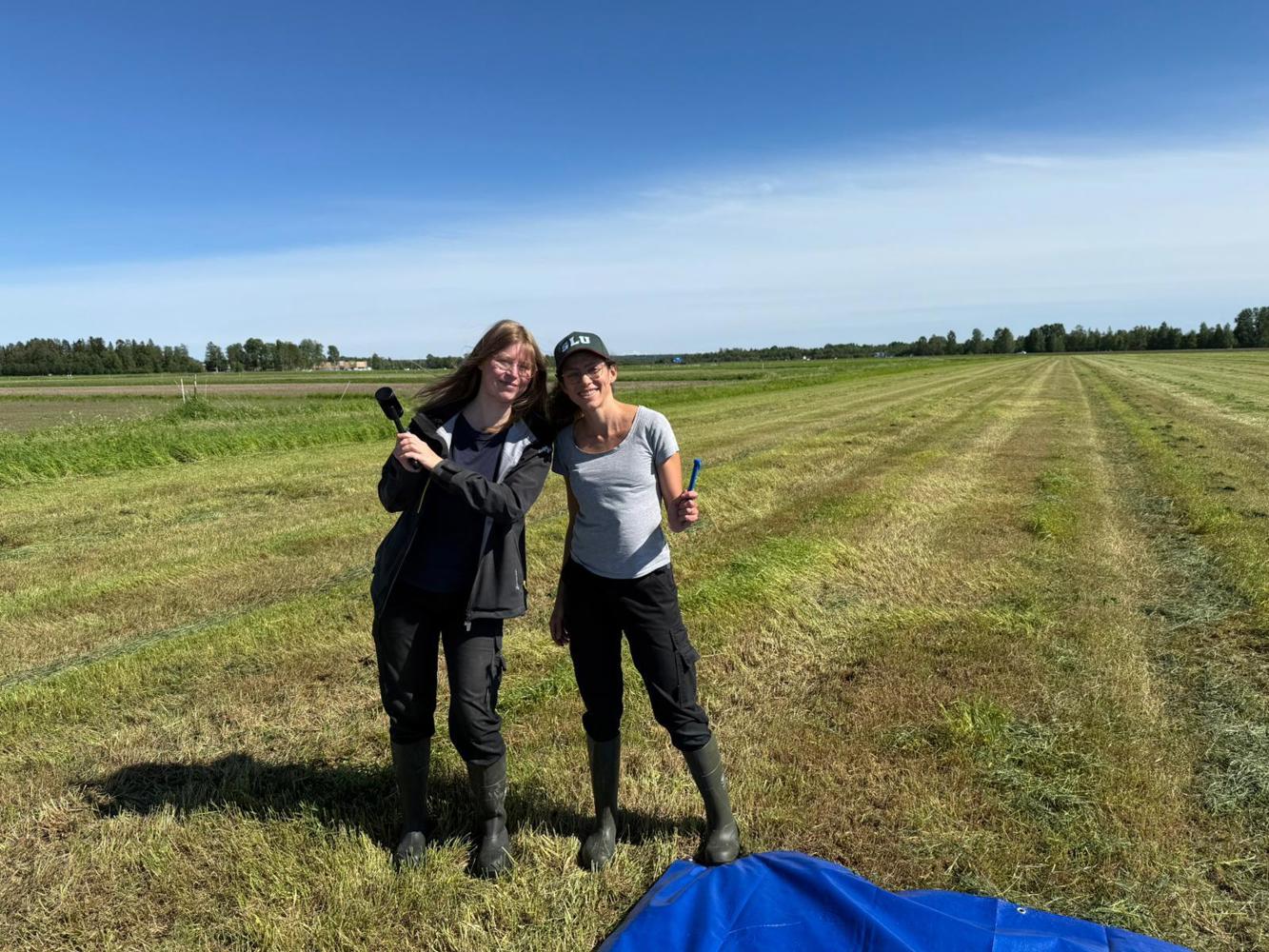
Sanna Bergqvist and Julianne de Castro Oliveira, researchers at SLU in Umeå.
The sensors see what the eye cannot
The project draws on three types of remote sensing: freely available satellite imagery from Sentinel-2, handheld nitrogen sensors, and tractor-mounted sensors of the kind many farmers already use. The satellite images allow the team to look into the past and identify parts of the field that have consistently over- or underperformed across multiple years. On the ground, the researchers collect reference data and measure the light reflected from the plants. That's where the technology provides something new. The human eye can see vegetation as green or yellow and sense that something is off. Sensors pick up wavelengths the eye simply can't see, catching early signs of nutrient deficiency or disease well before anything becomes visible.
– We work with the response of the vegetation to light. A lot of that information sits in wavelengths our eyes cannot see. That means we can detect problems before they show up, which gives the farmer time to act, says Julianne.
For Sanna Bergqvist, the value also comes down to scale. Manual sampling typically means collecting from small plots that are supposed to represent entire fields of several hectares.
– Trying to represent a whole field of several hectares with small samples can be very difficult. Remote sensing lets us scale this up and get a better overview, says Sanna Bergqvist.
The question came from the farmers themselves
The project grew out of something farmers had noticed in their own fields. Certain zones simply don't respond to nitrogen the way they should. Even though you're applying fertiliser, the crop isn't growing as expected compared to other parts of the field.
The work is structured in three main phases. First, Sentinel-2 imagery was used to assess historical data across four farms: a farm owned by SLU in Umeå, and three farms in central and western Sweden. Sentinel-2 is a European satellite programme with freely available imagery, which has opened remote sensing to far more research projects than would otherwise be possible.
In the second phase, the team spent two growing seasons collecting soil samples and sensor data from the identified high- and low-yield areas. In the third phase, field experiments are now underway, testing different fertilisation rates in both types of zones.
What the early results suggest is that there's rarely a single cause behind the variation. Soil type, elevation, weather and farm management all play a role. Some low-yielding areas stay low regardless of what you do. In those cases, it may simply make more sense to apply fertiliser in areas you know will respond better.
– One of the farmers in the project had already tried decreasing the amount of fertiliser in the lower-yielding parts of the field and putting it on the higher-yielding ones. That worked well. If we can explain why it worked, we can show other farmers that this can be a good idea for their farm too, if they've noticed similar issues, says Sanna.
Collaboration makes research useful
The project is a collaboration between Lantmännen Research Foundation, SLU, Yara and Dataväxt. The handheld and tractor-mounted sensors come from Yara, while Lantmännen Research Foundation has contributed both funding and the farmer contacts that made the project possible.
– This is an example of research that started with a real need. The question came from the farmers, the funding from the foundation, and the technical know-how from several directions. It's when you have multiple stakeholders involved that research becomes genuinely useful, says Julianne.
It also increases the likelihood of results actually being implemented in reality. Yara can feed new insights into their existing decision-support tools. Lantmännen plans to showcase the project for its members. An ongoing master's thesis carried out in collaboration with BOKU University in Vienna is helping bring the science on Nordic forage systems to an international audience.
The technology does not replace, it enhances
For Julianne de Castro Oliveira and Sanna Bergqvist, this was never about technology taking over. The farmer's own knowledge of the land remains the starting point. The sensors offer an extra pair of eyes with a wider view, able to pick up on things that would otherwise stay hidden until the harvest tells the story.
– Our main goal is that this is something that responds to a real need from farmers. Something that can help them make faster and more accurate decisions, help them save money, and improve how they manage their land in a more sustainable way, says Julianne.
With a year still to go, field experiments and analysis are ongoing. Looking ahead, the research could offer Swedish ley production something genuinely useful: a path towards precision cultivation where the right amount of fertiliser reaches the right place. The result would be higher and more consistent yields, lower input costs and a lighter environmental footprint, all built on the foundation of the farmer's own expertise.