In an uncertain time, Sweden’s food production can grow
Against an increasingly uncertain global backdrop, Swedish food companies and farmers are now investing for the future. Arla’s investment worth billions of kronor in the dairy facility in Götene, Lantmännen’s investment worth billions of kronor in a new plant-based protein facility in Lidköping, and Scan Sverige’s expansion of slaughter capacity in northern Sweden are concrete examples of how the industry is stepping up.
"Our major growth investments, including in Swedish grain infrastructure and in a new production facility for plant-based protein in Lidköping, show that the willingness, expertise, and investment capacity are all there in the food sector. We are doing our part to deliver on Livsmedelsstrategin (the Swedish Food Strategy). It is now important that politicians and public authorities do theirs. Livsmedelsstrategin needs clear political growth targets that are elevated to the level of national goals, just like the climate and environmental objectives," says Per Arfvidsson, Deputy CEO at Lantmännen.
"As a farmer-owned company, we invest together with Arla’s dairy farmers across the entire value chain, from farm to dairy. Milk production is the backbone of Sweden’s food supply and supports several parts of the food chain. For us to continue stepping up, permit processes must be shorter and regulatory frameworks more predictable," says Cecilia Kocken, CEO at Arla Sverige.
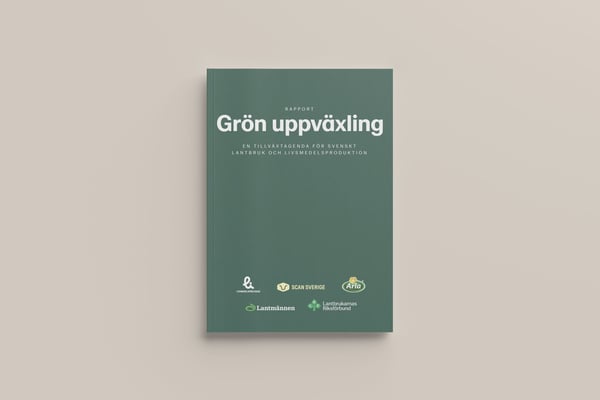
Food production, from farming to processing, is one of Sweden’s largest and most geographically dispersed industries, with around 100,000 people directly employed and annual revenues of more than SEK 300 billion. Beyond its obvious contribution to Sweden’s food supply, the sector is central to regional development, employment, and economic stability. The report Grön uppväxling shows that increased food production is possible while agriculture’s climate footprint and nutrient losses are reduced.
"With long-term political conditions in place, Sweden will be able to produce more and better food, reduce its dependence on the outside world, and at the same time strengthen both the climate and competitiveness. That is in the very nature of farming," says Erik Pihlo, Acting CEO of LRF.
"With Grön uppväxling, we show that Swedish food producers can and want to strengthen Sweden’s resilience even further in the most difficult security policy environment since the Second World War. Policymakers must now, once and for all, make clear — and show in practice — that a robust and profitable food production sector is essential to Sweden’s security and future. If politics removes the major bureaucratic barriers, our 750 member companies are ready to step on the gas," says Björn Hellman, CEO at Livsmedelsföretagen.
"For us, it is self-evident that increased domestic food production can be combined with sustainable development across the country. Northern Sweden, for example, has particularly favorable conditions, with large areas for feed cultivation and grazing land that make increased animal production possible," says Lars Appelqvist, CEO at Scan Sverige.
More facts and information
Report: Grön uppväxling – en tillväxtagenda för svenskt lantbruk och livsmedelsproduktion (in Swedish)
About the report: The report shows that society’s goals for food production can be achieved and that growth can take place in a sustainable way over the long term.
Background: The industry collaboration Grön uppväxling was launched in the autumn of 2025.
Purpose: To create a shared direction within the farming sector and the food industry around the view that food production can increase while environmental and climate goals are also met.
Basis: The report is based on existing reports, data, and analysis from experts across different parts of the sector.
Scope: The analysis covers key value chains from primary production to food processing in crop cultivation, meat, dairy, poultry, eggs, fruit, and vegetables.
Leading actors: Lantmännen, LRF, Livsmedelsföretagen, Arla, and Scan Sverige.
Participants: A broad group of companies, organizations, researchers, farmers, and other stakeholders contributed through meetings and dialogue.
For more information, please contact:
Lantmännen's Press Office
Tel: +46 10 556 88 00
E-mail: press@lantmannen.com